War with Russia by Stephen F Cohen
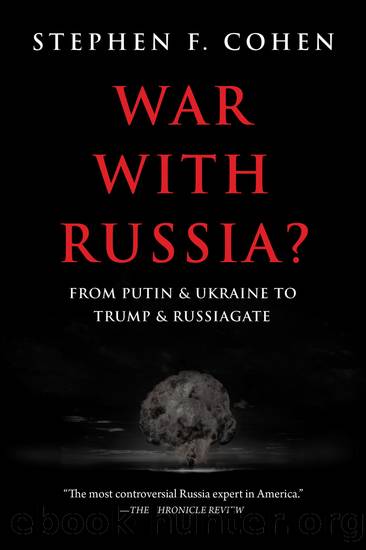
Author:Stephen F Cohen [Cohen, Stephen F]
Language: eng
Format: epub
Tags: non-fiction
ISBN: 9781510745810
Publisher: Hot Books
Published: 2018-11-09T05:00:00+00:00
The Silence of the Doves
September 20 / September 27
APERILOUS PARADOX: WHY, UNLIKE DURING THE 40-year Cold War, is there no significant American mainstream opposition to the new and more dangerous Cold War? In particular, from the 1960s through the 1980s, there were many antiâCold War, or pro-détente, voices in the American political-media-corporate establishmentâin the White House, Congress, State Department, political parties, influential print and broadcast outlets, universities and think tanks, major US corporations, even in elections.
That is, debates about Washington policy toward Moscow were the norm during the preceding Cold War, at the very top and at grassroots levels. as befits a democracy. As to the former, I can provide personal testimony. In November 1989, the first President George Bush convened at Camp David virtually his entire national-security team to attend a debate between myselfâI was then at Princeton and, as now, a pro-détente advocateâand Harvard professor Richard Pipes, a renowned âhardliner,â on the pressing issue of whether the détente under way with the Soviet Union under Gorbachev should be expanded or reversed.
And yet, today, despite escalating perils in US-Russian relations from the Baltic region and Ukraine to Syria, despite the circumstance that Russiaâs ruling elites are no longer Communists but professed capitalists, there is virtually none of that. Even the well-organized grassroots anti-nuke movement that once animated pro-détente politics in elections has all but vanished. In the vernacular of the preceding Cold war, political struggles between American âhawksâ and âdovesâ no longer exist. Everywhere, hawks prevail and doves are silent, even in corporations with major Russian investments.
I cannot explain this exceedingly dangerous paradox, only point out some partial factors:
The longtime demonization of Russian President Putin has been an inhibiting factor since the early 2000s. The vilification of President Trump has intensified it. Mainstream Americans skeptical about Washingtonâs Russia policies worry about being labeled âpro-Putinâ and/or âpro-Trump.â That anyone need worry about such slurs is deplorable, but they do.
There is also the neo-McCarthyism that has grown considerably since Trumpâs election. As official investigations into alleged âcollusion with Russiaâ become more promiscuous and well-funded campaigns to ferret out âRussian disinformationâ in US media unfold, a self-censoring chill has descended on policy discussions. No one wants to be suspected of âcollusion with the Kremlinâ or of conveying âRussian propaganda.â Nor is this merely self-censorship. Major media outlets regularly exclude critics of Washingtonâs Russia policy from their news reports, opinion pages, and TV and radio broadcasts.
On the other hand, some have argued that the persistence and prevalence of Cold War politics is best explained by a nativist American social tradition that âneeds an enemy,â and more often than not Russia has been assigned this role. Having grown up in Kentucky and lived in Indiana, Florida, New York, and New Jersey, I find no evidence for this âblame the peopleâ explanation. Nor do periodic opinion surveys.
The fault lies with Americaâs governing elites. Two recent developments illustrate that conclusion. US political-media elites fully expected that post-Soviet Russia would become, during the âtransitionâ of the 1990s, Washingtonâs junior and compliant partner in world affairs.
Download
This site does not store any files on its server. We only index and link to content provided by other sites. Please contact the content providers to delete copyright contents if any and email us, we'll remove relevant links or contents immediately.
| Arms Control | Diplomacy |
| Security | Trades & Tariffs |
| Treaties | African |
| Asian | Australian & Oceanian |
| Canadian | Caribbean & Latin American |
| European | Middle Eastern |
| Russian & Former Soviet Union |
The Secret History by Donna Tartt(19088)
The Social Justice Warrior Handbook by Lisa De Pasquale(12190)
Thirteen Reasons Why by Jay Asher(8910)
This Is How You Lose Her by Junot Diaz(6887)
Weapons of Math Destruction by Cathy O'Neil(6280)
Zero to One by Peter Thiel(5802)
Beartown by Fredrik Backman(5754)
The Myth of the Strong Leader by Archie Brown(5507)
The Fire Next Time by James Baldwin(5446)
How Democracies Die by Steven Levitsky & Daniel Ziblatt(5219)
Promise Me, Dad by Joe Biden(5153)
Stone's Rules by Roger Stone(5088)
A Higher Loyalty: Truth, Lies, and Leadership by James Comey(4964)
100 Deadly Skills by Clint Emerson(4925)
Rise and Kill First by Ronen Bergman(4789)
Secrecy World by Jake Bernstein(4753)
The David Icke Guide to the Global Conspiracy (and how to end it) by David Icke(4720)
The Farm by Tom Rob Smith(4512)
The Doomsday Machine by Daniel Ellsberg(4490)
